

 Previous
Crypto Outlook 2026
December 18, 2025 - Staff
Between institutional adoption, regulation, and a new monetary geopolitics
- Bitcoin: from emerging asset to strategic store of value
- Crypto ETFs: the definitive bridge to traditional finance
- MiCAR and Europe: from fragmentation to institutionalization
- Corporate treasuries, central banks, and sovereign wealth funds
- Stablecoins: from technological innovation to geopolitical lever
- CheckSig in 2025 and the outlook for 2026
2025 marked a pivotal year for digital assets. Bitcoin and cryptocurrencies have definitively moved beyond the experimental phase, becoming an integral part of the global financial architecture. CheckSig’s Crypto Outlook 2026 captures this transition - from an emerging market to a mature asset class increasingly integrated into institutional portfolios, corporate balance sheets, and national geopolitical strategies - while identifying the key trends that will shape 2026. The report offers a strategic guide for investors, companies, and policymakers navigating this new phase of the crypto economy.
Bitcoin: from emerging asset to strategic store of value
2025 established itself as a record-breaking year for Bitcoin, marked by four new all-time highs and culminating in a price exceeding $126,000. This milestone reinforces Bitcoin’s role as the sector’s benchmark asset, capable of leading the broader ecosystem and demonstrating resilience during periods of market instability.
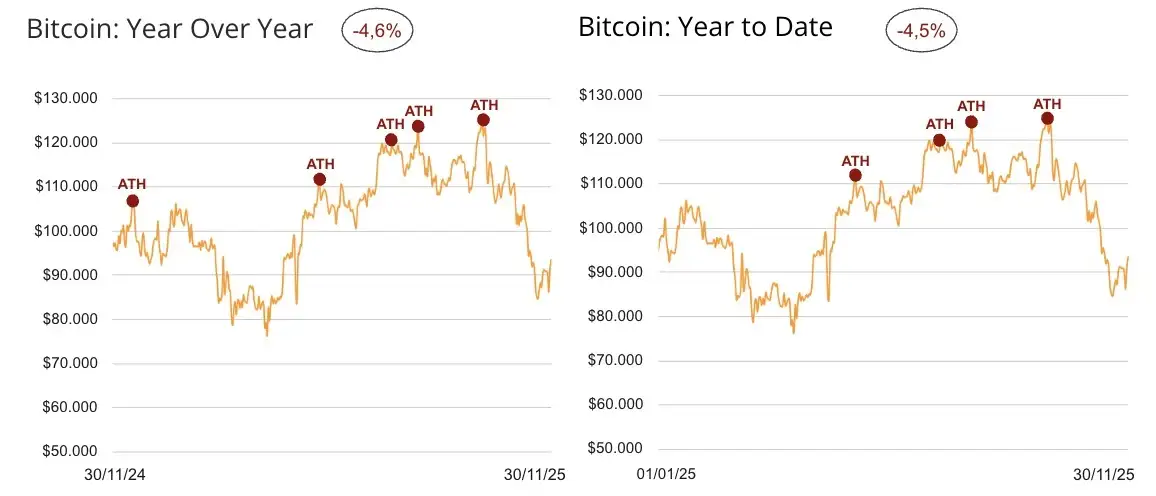
Short-term corrections, which temporarily erased annual performance, are no longer perceived as existential shocks but as normal retracements within a maturing asset class. The extreme drawdowns of the past - sometimes exceeding 90% - are increasingly a thing of the past. Today, corrections typically range between 20% and 30%: still significant, but comparable to those observed in U.S. technology equities, with which Bitcoin shares structurally high volatility.
Even more compelling is Bitcoin’s risk-return profile. Despite recent pullbacks, Bitcoin’s Sharpe ratio has reached levels well above those of traditional asset classes. From a portfolio perspective, Bitcoin’s low correlation with gold and equity markets enhances its value as a diversification tool. Conversely, its strong correlation with the broader crypto market suggests that intra-crypto diversification provides limited benefits compared to direct exposure to Bitcoin itself.
2026 View: Bitcoin will further consolidate its role as a global store of value and strategic asset, progressively shedding its speculative character and becoming a stable, recognized component of institutional finance. While speculative dynamics will not disappear entirely, their impact will continue to diminish. Drawdowns are expected to remain contained, while European institutionalization will introduce new capital flows and structurally supportive price dynamics.
Crypto ETFs: the definitive bridge to traditional finance
The launch of Bitcoin ETFs in 2024 represented a point of no return. Since then, the market has seen an expansion of offerings, including ETFs on Ether, Solana, XRP, and Dogecoin. However, the data is unequivocal: only Bitcoin ETFs have attracted consistent and meaningful inflows.
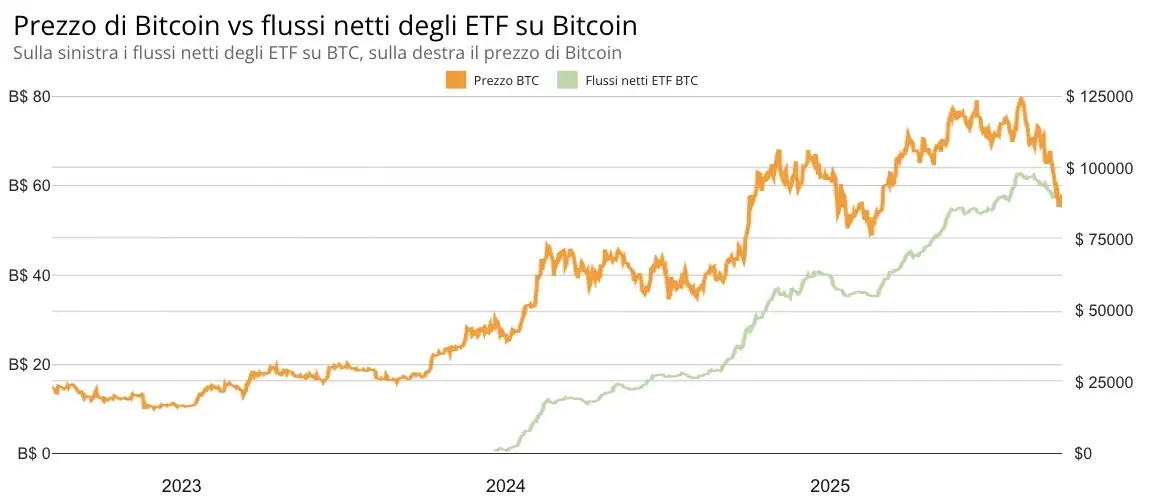
The success of BlackRock’s fund - setting unprecedented records for ETF inflows - demonstrates that institutional demand remains heavily concentrated on the asset perceived as the most robust, liquid, and reliable. ETF flows have acted as a powerful price catalyst, further strengthening the connection between traditional finance and the crypto market.
2026 View: Bitcoin ETFs will become the primary access point for institutional capital, while ETFs on other crypto assets will remain niche instruments, suited to higher-risk investors or tactical allocations. The market will continue to evolve toward a model in which traditional finance and the crypto economy converge around a limited set of selected assets, with Bitcoin at the core of this new investment infrastructure.
MiCAR and Europe: from fragmentation to institutionalization
With the entry into force of the MiCAR regulation, the European Union has finally established a clear and harmonized regulatory framework. 2025 marked the beginning of the sector’s institutionalization process, the full effects of which will unfold over the next 18-24 months.
Germany, the Netherlands, and France lead in terms of licenses issued, while Italy stands out for its particularly rigorous approach. Of the approximately 150 operators registered with the Italian OAM, only a small fraction have effectively embarked on the authorization process. This environment points to a significant market consolidation.
Thanks to an advanced operating model since its inception - independent proof of reserves, insurance coverage, SOC attestations, and a robust governance structure - CheckSig is positioned among the very few operators ready to operate fully under the MiCAR regime.
2026 View: Europe will see the emergence of a crypto market dominated by regulated financial operators. The next 18-24 months will mark the sector’s full maturation: banks’ entry will broaden the investor base and unlock capital previously restrained by caution, profoundly reshaping market dynamics.
Corporate treasuries, central banks, and sovereign wealth funds
2025 marked the stable inclusion of Bitcoin in corporate treasuries as a strategic reserve asset. Approximately 7% of all circulating Bitcoin is now held by corporations, with an estimated value of $130 billion, excluding indirect exposure via ETFs.
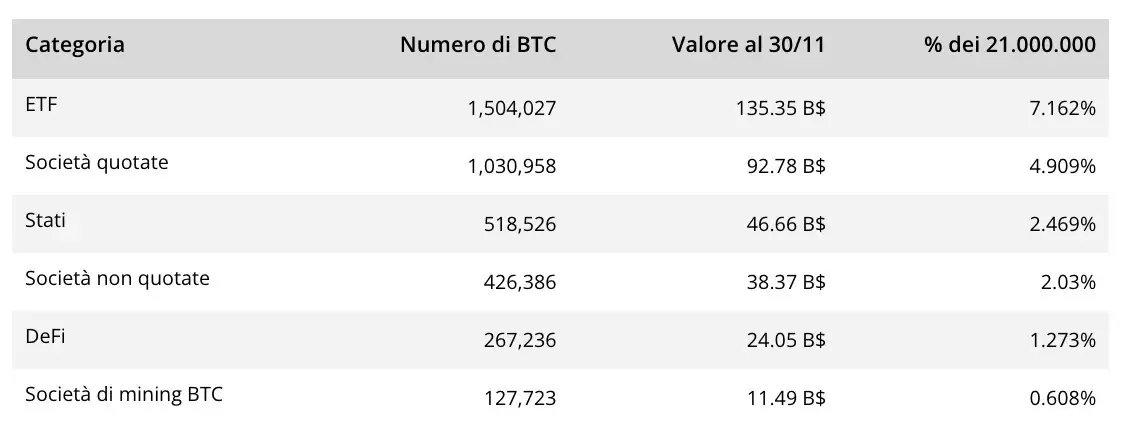
While recent price pressure has been partly driven by concerns over companies’ ability - such as Strategy and others - to service debt obligations without selling Bitcoin, the entry of states and public institutions is redefining Bitcoin’s role. The United States has established a strategic reserve, Luxembourg and the Czech Republic are testing official allocations, and other countries are evaluating similar initiatives.
2026 View: Bitcoin will further consolidate as a component of corporate and sovereign reserve strategies, with long-term implications for its scarcity and price dynamics. An increasing number of treasuries and governments will recognize its diversification benefits and scarcity-driven value proposition. This process is expected to continue, with further reinforcement as financial institutions progressively enter the space, while the inclusion of Bitcoin in central bank reserves remains a longer-term prospect.
Stablecoins: from technological innovation to geopolitical lever
Throughout 2025, stablecoins have emerged as a strategic pillar of global digital finance. Growing transaction volumes, operational adoption, and increasing institutional and political attention have positioned stablecoins at the center of economic and geopolitical dynamics.
In the United States, the enactment of the GENIUS Act introduced the first dedicated regulatory framework for stablecoin issuance. In parallel, China is evaluating the launch of a yuan-pegged stablecoin to strengthen the international use of its currency and reduce reliance on the U.S. dollar in global payments.
In contrast, Europe appears more cautious and fragmented. The digital euro project promoted by the ECB continues to progress slowly. Private actors, however, are moving faster: ten European banks have formed a consortium to develop a privately issued euro-denominated stablecoin. The initiative includes two Italian banks, UniCredit and Banca Sella.
2026 View: Stablecoins will continue to grow as instruments of economic and monetary policy, increasingly serving as a bridge between the crypto ecosystem and traditional finance. While the sector has so far been dominated by the United States and China, European involvement is expected to intensify in the coming months, driven primarily by private banking initiatives.
CheckSig in 2025 and the outlook for 2026
2025 confirmed CheckSig as a leading player in the Italian crypto market, consolidating the growth trajectory of previous years. By combining security, transparency, and regulatory compliance, the company achieved record results, demonstrating that robust infrastructure and innovation can coexist effectively.
By the end of Q3 2025, CheckSig’s key metrics showed strong year-on-year growth:
- Revenue: EUR 1.3 million over the last 12 months (+136% YoY)
- Assets under custody: over EUR 170 million (+127% YoY)
- Trading volumes: over EUR 60 million per year (+117% YoY)
- Clients: more than 1,100 (+109% YoY)
These results reflect CheckSig’s ability to attract both capital and new clients, strengthening trust among sophisticated retail investors and institutional participants alike.
In 2025, CheckSig launched its Crypto Accumulation Plans (PACs), designed to help clients build digital wealth gradually while mitigating market volatility. At the same time, the Crypto Tax Substitute Service reinforced fiscal compliance for investors, contributing to CheckSig’s recognition as “Best Fintech” at the Banking Awards 2025.
These initiatives exemplify CheckSig’s approach: combining innovation, reliability, and investor protection to guide the evolution of the Italian crypto market.
CheckSig’s vision for 2026
In 2026, CheckSig will focus on new strategic initiatives and an expanded product offering, further strengthening its position as a national benchmark. The company’s goal is to continue delivering cutting-edge solutions that integrate security, transparency, and compliance, while leading the market into its next phase of maturity.
This content is provided for informational purposes only and does not constitute financial, legal, or tax advice, nor a recommendation to invest. Crypto-assets are highly volatile instruments, and investing in them may result in the partial or total loss of capital. Past performance is not indicative of future results.



Open an account
With your account, you have access to all CheckSig services. Great services, at competitive rates.
Contact us
See the FAQs. For further questions or enquiries, our support is always available.












© CheckSig Suisse AG - CHE-183.628.610