



 Previous
Bitcoin in European banks: the Intesa Sanpaolo case confirms an ongoing trend
February 20, 2026 - Staff
From Bitcoin ETFs issued by BlackRock and Fidelity Investments to MiCA licenses pursued by Santander, BBVA and Commerzbank, the integration of crypto-assets into traditional finance is accelerating. According to Ferdinando Ametrano (CheckSig), this is not a sudden turning point, but the natural evolution of a process that is now irreversible.
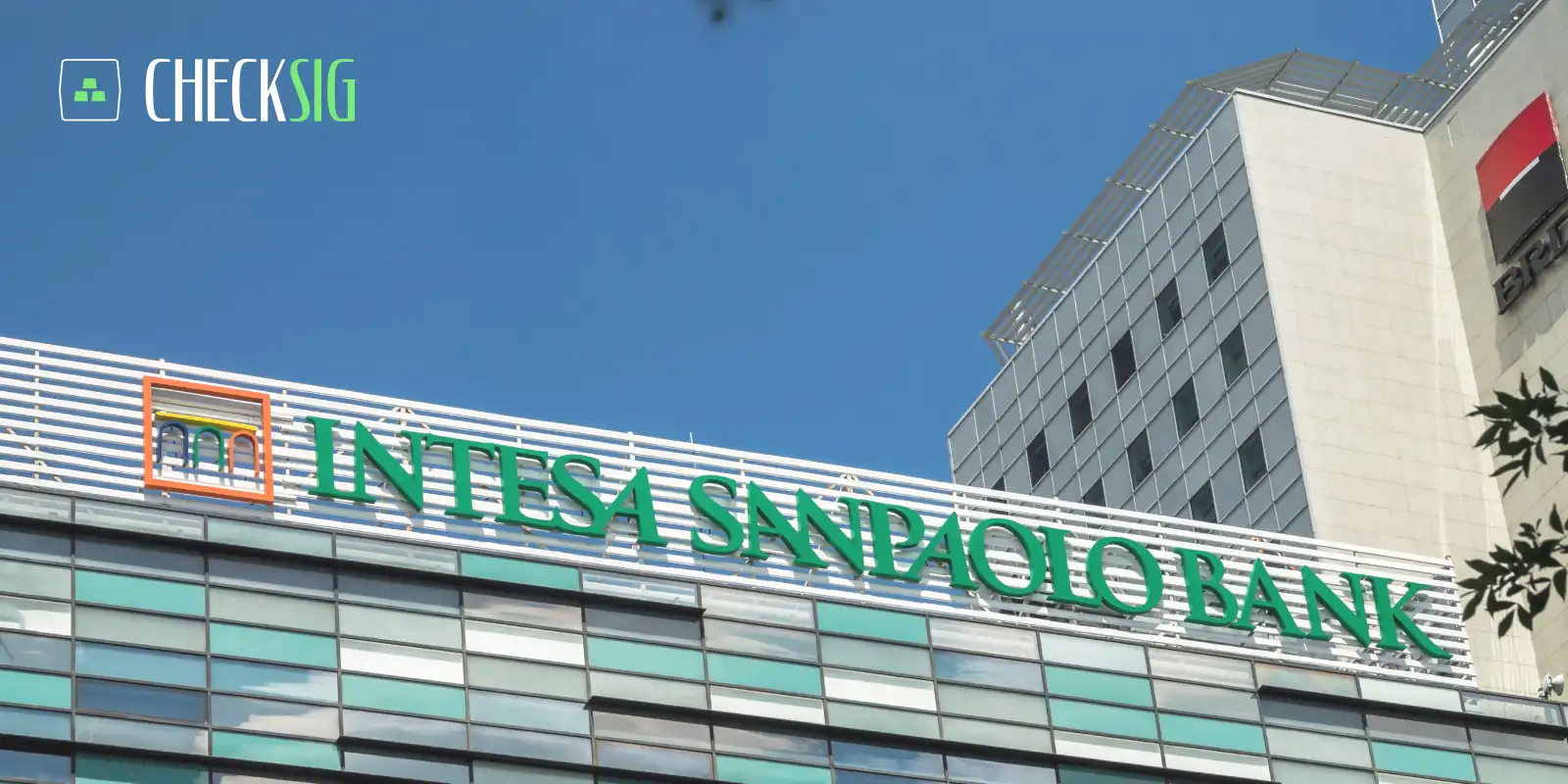
Milan, February 19, 2026 - Intesa Sanpaolo’s disclosure of an approximately $100 million exposure to Bitcoin ETFs, alongside a hedging strategy involving Strategy, brings into the spotlight a development that industry insiders had long anticipated: European banks are moving from observation to active participation in crypto-assets.
Seasoned market participants have followed the evolution of banks’ approach to Bitcoin for years and were already aware that Intesa Sanpaolo had been investing in listed instruments linked to BTC, initially through ETNs and later via ETFs. In January 2025, the bank formalized the purchase of 11 Bitcoin.
An increasing number of institutions, including Intesa Sanpaolo, have established proprietary trading desks focused on digital assets. While regulators limited the ability of banks to offer crypto services directly to retail clients, many institutions developed proprietary exposures, adopting a long-term industrial and strategic perspective. After all, banks could hardly ignore an asset that delivered extraordinary performance in 11 of the past 14 years, emerging as one of the best-performing assets in the global financial landscape.
The evolution of European banking offerings has been gradual: from indirect exposure, to the structuring of products and operational processes, to the more sophisticated use of regulated instruments for position and risk management. The momentum is global. The success of Bitcoin ETFs in the United States, attracting inflows in the tens of billions of dollars, has contributed to normalizing Bitcoin as an allocable asset within institutional portfolios.
In Europe, groups such as Crédit Agricole, Santander, BBVA, Société Générale, BNP Paribas, Commerzbank, Deutsche Bank and Intesa Sanpaolo have launched initiatives, through different models and timelines, opening the door to operations involving Bitcoin and related instruments. In Italy, UniCredit has also shown openness through structured products and participation in stablecoin projects in consortium with other banks. Alongside major banking groups, more agile players such as Tinaba, Hype and Revolut have offered exposure to crypto-assets for years.
The European regulatory framework is another key catalyst. Numerous international operators have initiated the MiCAR authorization process, and among the early movers are traditional banking names such as BBVA and Commerzbank. This signals that the market is structuring itself within the perimeter of supervised finance, with compliance, governance and risk management standards comparable to those applied to other financial instruments.
The “turning point” of 2025, therefore, did not mark the beginning of the phenomenon but rather its public emergence. What is set to change in the near term is primarily the distribution channel: investing in Bitcoin will increasingly occur through traditional supervised intermediaries, integrating the asset into mainstream banking services.
As Ferdinando Ametrano, CEO of CheckSig, comments: “It was only a matter of time. As I have repeatedly stated, 2026-2027 will mark the structural entry of major Italian and European banking groups into Bitcoin. Institutional adoption is an irreversible process.”



Open an account
Your account gives access to all CheckSig services. Impeccable services on extremely favorable terms.
Contact us
Need clarification? Have specific needs? Contact our support team, always available.












© CheckSig Suisse AG - CHE-183.628.610