



 Previous
Crypto market: Q4 ends in the red, but institutionalization accelerates
January 27, 2026 - Staff
Q4 2025 closes a pivotal year for Bitcoin and the crypto ecosystem
Milan, January 27, 2026 - The Digital Gold Institute, the research arm of CheckSig and Europe’s leading think tank specializing in Bitcoin, crypto-assets, and blockchain, has published the twenty-eighth edition of its quarterly report on the crypto ecosystem.
The report shows that the recent price correction has not slowed the sector’s path toward maturity and consolidation at a global level. On the contrary, market dynamics have highlighted the ecosystem’s structural strength and growing resilience, confirming the strategic interest of investors, institutions, and industrial players. 2025 thus emerges as a year of transition, less driven by speculation and increasingly oriented toward long-term institutional adoption.
Bitcoin resilient, altcoins under pressure
The fourth quarter of 2025 concludes a year of profound transformation for the crypto-asset market. During Q4, Bitcoin recorded a 23% decline, demonstrating greater resilience compared to major altcoins, which experienced sharper corrections: Ether fell by 28%, Ripple by 35%, and Solana by 42%.
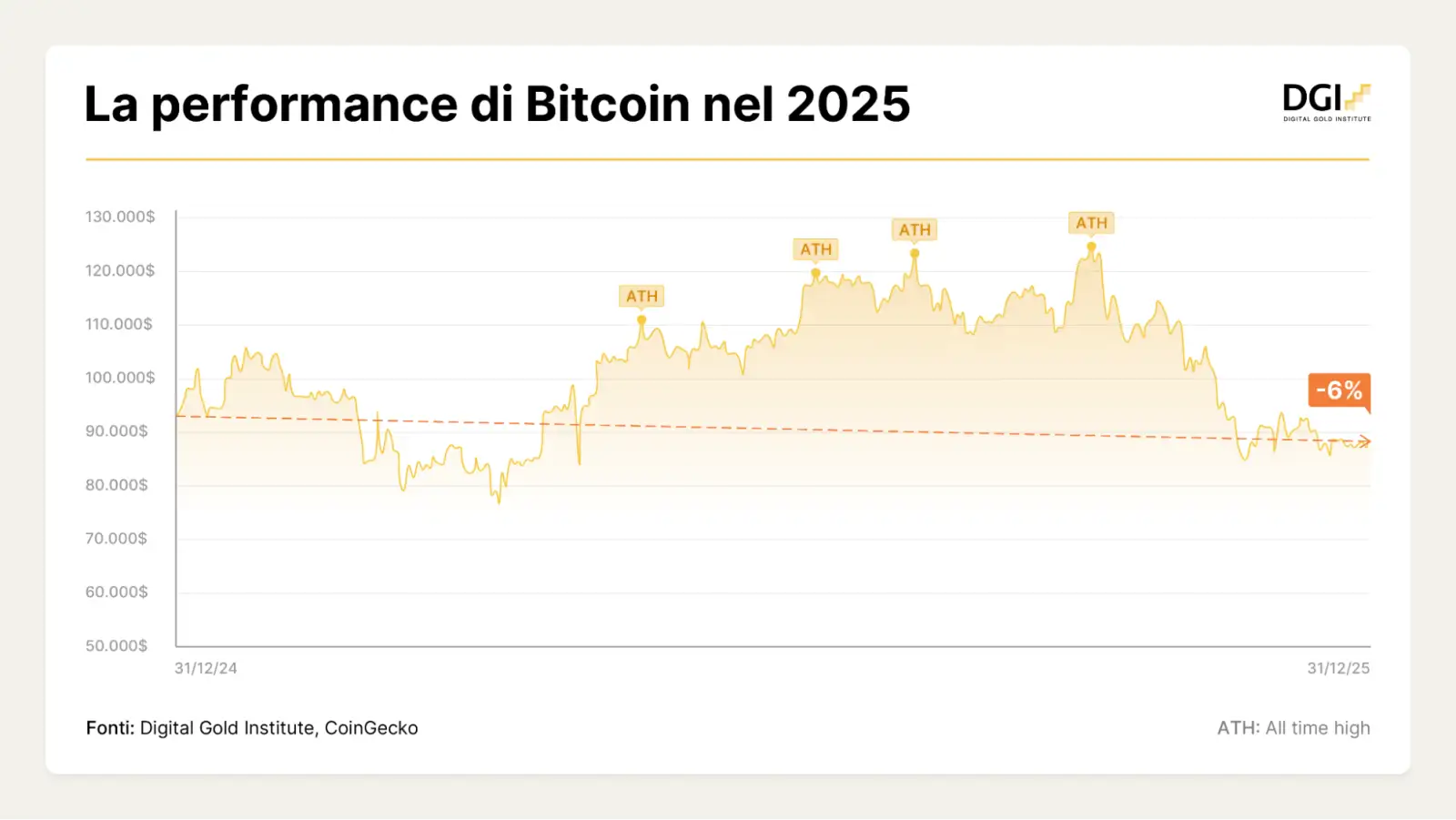
Looking at the full year 2025, price dynamics offer a more balanced perspective than quarterly movements alone. Bitcoin closed 2025 with a slightly negative performance (-6%), significantly more contained than that of major altcoins, reaffirming its role as the dominant asset within the ecosystem. Despite the marginally negative close, 2025 remains a meaningful year for Bitcoin, marked by four new all-time highs.
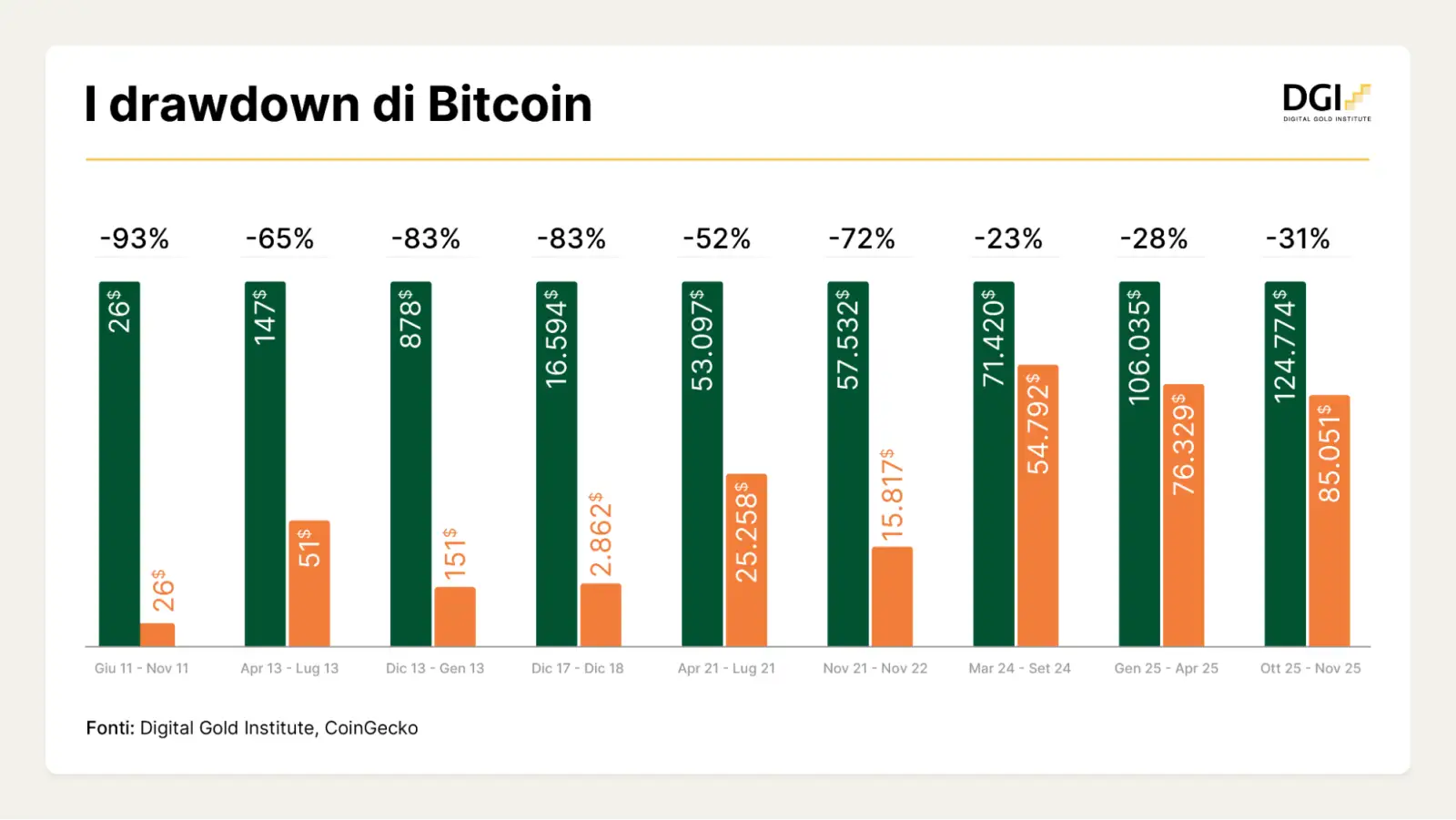
After a strong rally in the first part of 2025, the market entered a normalization phase. Whereas in the past market reversals often resulted in generalized collapses, with Bitcoin drawdowns exceeding 80%, the 2025 correction proved more orderly, supported by greater liquidity, deeper markets, and an institutional presence that is now structurally embedded.
The performance of crypto ETFs
The crypto ETF segment also experienced a slowdown. The fourth quarter saw the launch of the first ETFs on XRP and Solana, marking further progress toward the integration of crypto assets into traditional finance; however, investor interest did not translate into significant inflows.
Bitcoin ETFs showed greater resilience: during Q4, outflows amounted to approximately USD 0.9 billion out of a total of USD 56 billion, while Ether ETFs recorded outflows of USD 0.4 billion out of USD 12 billion, indicating relatively higher pressure in that segment.
Institutional adoption continues to strengthen
Despite market weakness, institutional adoption of Bitcoin continued to grow. Central banks, sovereign wealth funds, and institutional investors increased their crypto reserves, with notable participants including the Czech National Bank, the Luxembourg Intergenerational Fund, the Abu Dhabi Investment Council, and Harvard.
“The message emerging from Q4 2025 is clear: short-term volatility does not undermine the long-term trajectory,” comments Ferdinando Ametrano, Scientific Director of the Digital Gold Institute. “Bitcoin continues to consolidate as an emerging global monetary asset, with an ever-growing presence in institutional portfolios.”
Stablecoins gain momentum, CBDCs slow down
Q4 was also marked by significant structural developments. Institutional interest in stablecoins increased, alongside the strengthening of global, bank-led projects, underscoring the progressive integration of digital assets into the traditional financial system.
At the same time, Q4 confirmed a slowdown in several retail CBDC projects still under development. The growing commitment of banks to digital assets represents a key factor in understanding market consolidation, even during a phase characterized by price corrections.
The European regulatory landscape
In the context of rising institutional adoption, the European regulatory framework plays a central role. As of December 31, 2025, 133 MiCAR licenses had been issued in Europe, with Germany, the Netherlands, and France leading the way; this is evidence of the sector’s full integration across major EU countries.
Italy remains behind: by the end of 2025, no MiCAR licenses had been granted, and the increase in capital gains tax on crypto-assets from 26% to 33% signals a limited strategic vision. Nevertheless, the market is still at an early stage and offers significant opportunities for institutions willing to enter. “Italy shows a clear mismatch between demand and supply,” Ametrano concludes. “More than 2.5 million Italians hold a crypto account, yet the national financial system has not yet seized this opportunity. Bridging this gap will be crucial for future competitiveness.”



Open an account
Your account gives access to all CheckSig services. Impeccable services on extremely favorable terms.
Contact us
Need clarification? Have specific needs? Contact our support team, always available.










© CheckSig S.r.l. Società Benefit - P.IVA 11028330964