



 Previous
Bitcoin Passes 20 Million Issued as the Final Million Stretches Over a Century
March 9, 2026 - Staff
On March 9, 2026, bitcoin issuance passes the 20 million mark. About 95% of the maximum supply has now been issued, yet it will take more than a century to complete the final million.
With block 940,000, the Bitcoin blockchain reaches 20 million bitcoin issued out of the protocol’s maximum supply of 21 million. The milestone is reached on March 9, 2026, during Bitcoin’s fifth era: every 210,000 blocks—roughly every four years—the block subsidy is cut in half in an event known as the halving, ushering in a new era. Following the fourth halving in April 2024, issuance fell to 3.125 bitcoin per block, down from the original 50 bitcoin per block in 2009.
Because a new block is produced roughly every 10 minutes, around 450 new bitcoin per day are being issued during this fifth era. At current prices, that amounts to an annual flow worth tens of billions of dollars, used to compensate miners—the operators who finalize transaction blocks and help secure the network. After the next halving, expected in 2028, daily issuance will fall to roughly 225 bitcoin per day. So far, bitcoin’s price appreciation has more than offset the impact of each halving, making mining an increasingly rewarding activity over time.
This progressive slowdown is the most distinctive feature of Bitcoin’s issuance model. That is why issuing the final portion of the 21 million supply will take another 114 years. A single bitcoin is divisible into 100 million units, known as satoshis, in tribute to Bitcoin’s creator, Satoshi Nakamoto. Over time, the block subsidy keeps halving until it falls to one satoshi after the 32nd halving, and then drops to zero after the 33rd halving.
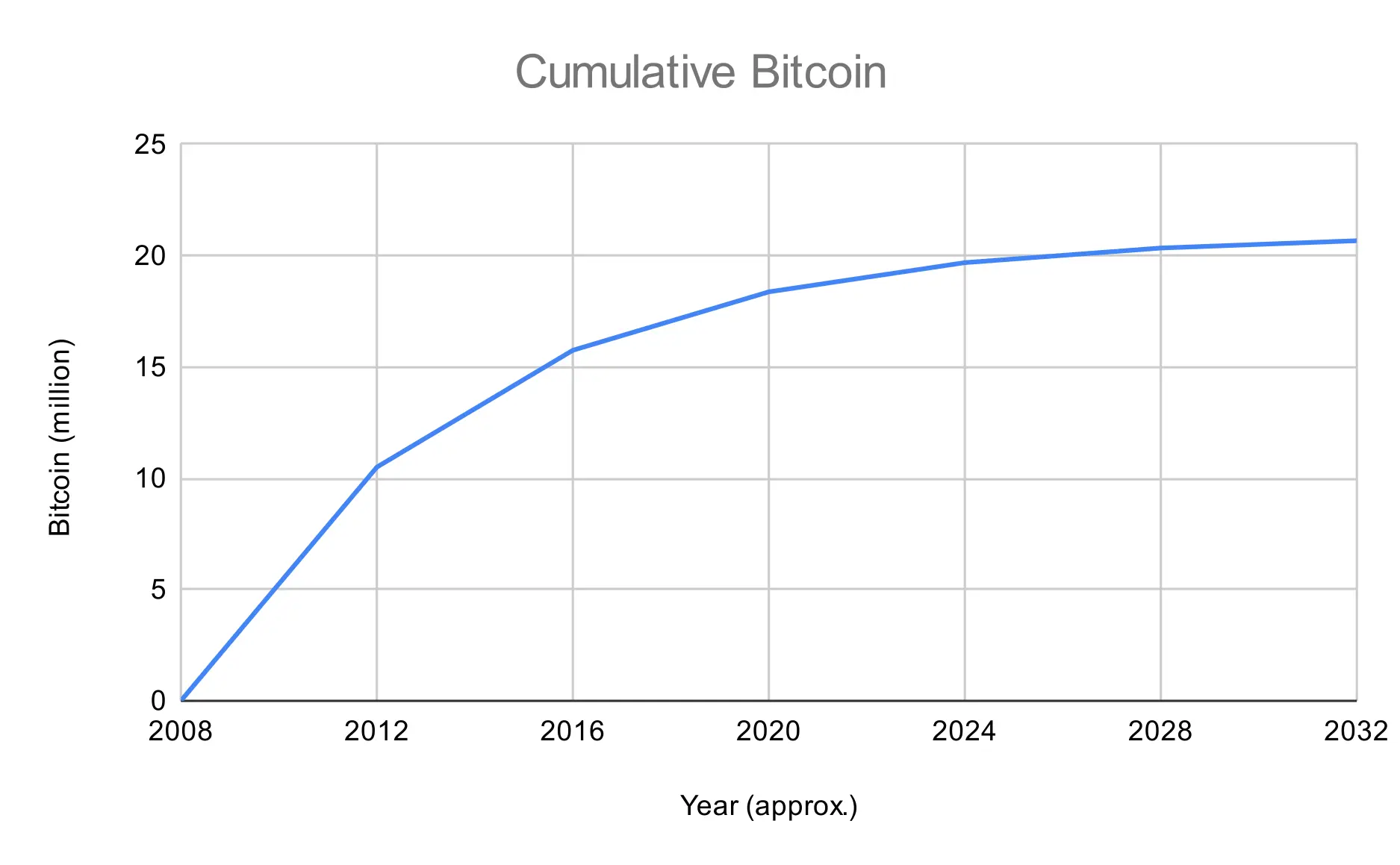
More than a celebratory milestone, the 20 million mark is a structural proof point: more than fifteen years after its launch, Bitcoin is still following exactly the issuance path set out in its protocol, without relying on discretionary decisions.
Another factor reinforces this scarcity. According to Chainalysis estimates, between 2.3 million and 3.7 million bitcoin have been lost—that is, they are associated with addresses whose private keys are permanently inaccessible. As a result, the amount of bitcoin actually available on the market is likely far below the 20 million already issued.
The reduction in new issuance does not prevent investors from building exposure to bitcoin over time. In a context of growing scarcity and high price volatility, a dollar-cost averaging approach—through regular purchases of fixed amounts—can help mitigate risk while remaining consistent with a long-term investment perspective.
As Ferdinando Ametrano, CEO of CheckSig, observes: “Bitcoin’s progressively slowing issuance mirrors gold’s progressively increasing extraction scarcity. The amount of gold extracted each year is marginally negligible compared to that already extracted in human history. The same is true for bitcoin, the quintessential scarce digital asset, which for this reason as well reinforces its role as gold’s digital equivalent. And investors are showing a growing appetite for both gold and bitcoin.”
If the 20 millionth bitcoin marks a historic milestone in the protocol’s trajectory, while the 21 millionth remains a distant destination, one point remains unchanged: for investors, understanding Bitcoin’s fundamentals is still the real starting point.



Open an account
Your account gives access to all CheckSig services. Impeccable services on extremely favorable terms.
Contact us
Need clarification? Have specific needs? Contact our support team, always available.













© CheckSig S.r.l. Società Benefit - P.IVA 11028330964